How Much Does It Cost to Build a Pond in North Texas?
Digging a farm or ranch pond runs $5,000 to $20,000 in HomeAdvisor’s numbers, and Fixr puts a one-acre pond at $10,000 to $20,000. Lawn Love lists $3,750 to $13,000 for a farm pond, and HomeGuide prices ponds under 10 acres at $3,000 to $15,000 per acre. There is no separate North Texas price index.
| What you are pricing | Published range | Source |
|---|---|---|
| Farm pond, digging | $5,000–$20,000 | HomeAdvisor |
| Farm pond | $3,750–$13,000 | Lawn Love |
| One-acre pond | $10,000–$20,000 | Fixr |
| One-acre pond | $7,000–$25,000 | HomeAdvisor |
| Per acre, ponds under 10 acres | $3,000–$15,000 | HomeGuide |
| Per acre, larger ponds and lakes | $2,000–$25,000 | HomeAdvisor |
| Per cubic yard, large pond | $1.50–$4.00 | HomeGuide |
| Per cubic yard, large pond | $1.50–$3.50 | HomeAdvisor |
| Excavator, per hour | $100–$300 | HomeGuide |
| Labor, per hour | $50–$200 | HomeAdvisor, Fixr |
Those are published national ranges, not a quote. HomeAdvisor’s overall pond average of $3,382 runs under all of it, because backyard ponds fill most of that sample. A real number needs someone standing on the ground. Our pond construction and stock tank work is priced at the property, free.
What drives the price of a ranch pond up or down?
Dirt volume sets the price. A pond is priced by the cubic yard and by the hour, so depth and width move the number most. After that come the shape of the ground, the spillway, where the spoil ends up, and whether the machines can reach the spot.
USDA’s Agriculture Handbook 590 gives the capacity rule. Acre-feet equal 0.4 times the surface acres times the maximum water depth at the dam. A one-acre pond 10 feet deep at the dam holds about 4 acre-feet. One acre-foot is 43,560 cubic feet, or about 1,613 cubic yards, so that pond is near 6,450 cubic yards of dig.
Put that against published rates. HomeGuide puts large pond digging at $1.50 to $4.00 per cubic yard, and HomeAdvisor lists $1.50 to $3.50. At those rates, 6,450 yards runs about $9,700 to $25,800 for the excavation alone.
Hourly pricing tells the same story. HomeGuide puts an excavator at $100 to $300 per hour. HomeAdvisor puts labor at $50 to $200 per hour per worker, and Fixr lists $50 to $200 per hour.
Where the pond sits changes how much of that volume you pay for. A pond built across a draw catches water the land already sends that way, and dirt out of the basin goes into the dam. A tank dug on flat ground gets no help, so every yard comes out and has to go somewhere.
A dam also needs a spillway, so overflow leaves without cutting through it. That shape belongs to the plan, and where TCEQ dam-safety rules apply, a licensed engineer designs it.
Spoil is the other swing. Dirt spread and leveled on your own place costs less than dirt trucked off. HomeAdvisor puts cut-and-fill at $1 to $12 per cubic yard and names haul distance as the reason for that spread. A pond is dirt work priced by the yard. When a dig makes more dirt than the job needs, our trucks and trailers haul the extra off the place.
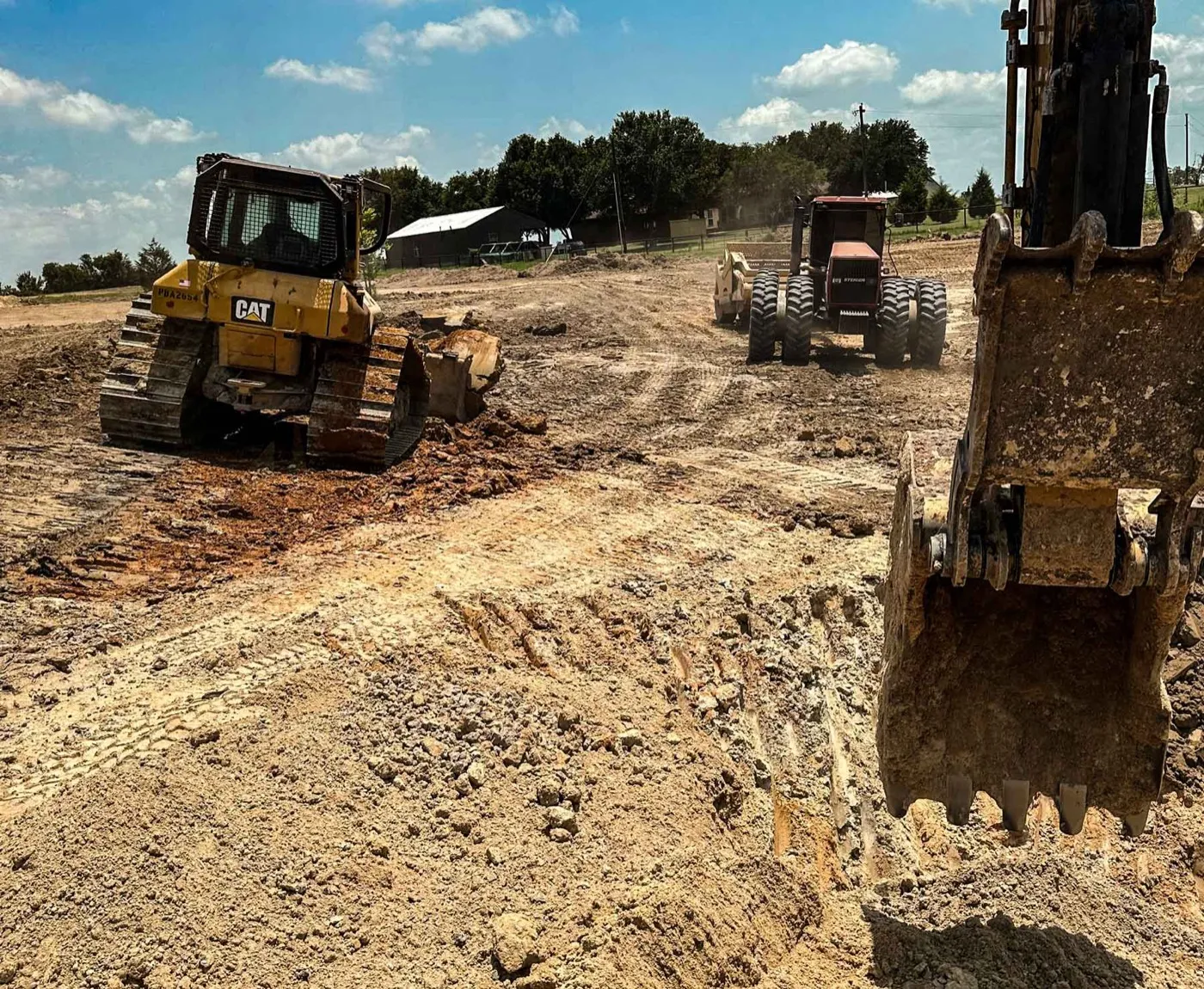
Access is the last driver. Our excavators run from a compact Bobcat E88 up to Kobelco 140, 270 and 350 machines, with dozers and wheel loaders behind them. They move the most dirt per hour, and they need room to work. Brush and trees in the footprint come out first, which is lot and brush clearing with machines.
Will a pond hold water on North Texas soil?
That depends on what sits under the topsoil, and it can change inside a few miles here. Handbook 590 says the pond bottom needs an impervious layer. Clays and silty clays are excellent for that, and sandy and gravelly clays are usually satisfactory. Sand and gravel on their own are the trouble.
The ground across this service area is not one soil. The Texas State Historical Association describes eastern Johnson County as Blackland Prairie, with deep clayey alkaline soils. The western half is Grand Prairie, where the soil is alkaline loam over limestone. Johnson County’s primary natural resources are sand and gravel, and the Eastern Cross Timbers band through it carries sandy soils.
Tarrant County splits the same way, with Blackland Prairie clay and loam in the southeast and a Grand Prairie belt of shallow clayey soil over alternating limestone and marl.
AgriLife’s Texas Farm Ponds manual puts a number on the soil question. Compactable soil with at least 30 percent clay is what keeps seepage down. Handbook 590 adds a depth rule. Go deeper where a year-round supply matters, or where seepage losses pass 3 inches per month.
A few test holes in the footprint show what the dirt is before the real digging starts. A lab test or an engineer’s design is a separate call, and that one is yours.
Our part is digging and shaping the pond and the dam to the plan. The fill gets packed in layers as it goes in. Tarrant and Johnson Counties sit on heavy clay that swells wet and shrinks dry, so those layers get the attention.
How deep should a pond be here?
Deep enough that a dry summer does not take it. Handbook 590 puts a fish pond’s floor at a minimum 8 feet of depth over roughly 1,000 square feet. AgriLife calls for 12 to 16 feet of deep water in part of the pond where summer drawdowns get severe. Wide shallow water is the part to keep small.
Under three feet, sunlight reaches the bottom and feeds weeds. Handbook 590 says to avoid large areas of shallow water for the same reason, plus what those flats lose to evaporation. AgriLife’s answer is bank slopes of at least 2.5:1, which keeps a wide shallow shelf off the edge.
Evaporation is the North Texas problem. NOAA’s normal annual precipitation is 37.01 inches at DFW Airport and 35.34 inches at Fort Worth Meacham Field. The Texas Water Development Board puts average annual gross lake evaporation under 45 inches in East Texas. In Far West Texas it runs over 90 inches. Even the low end beats our rainfall, so a pond loses more off its surface each year than falls on it.
Depth is also yards. Run the Handbook 590 rule on one surface acre: 8 feet at the dam gives 3.2 acre-feet, and 10 feet gives 4. That is about 1,300 more cubic yards to dig and move. Spoil that stays on the place gets spread and leveled, and that finish work is grading and site prep after the dig.
Do you need a permit to build a pond in Texas?
Usually not. Texas Water Code 11.142 covers a dam or reservoir on your own property. Normal storage of up to 200 acre-feet for domestic and livestock purposes needs no water-right permit from the state. The same exemption covers fish and wildlife ponds on qualified open-space land. It does not apply to a commercial operation.
Dam safety is a separate question. TCEQ jurisdiction reaches a dam 25 feet or taller holding 15 acre-feet or more, and a dam over 6 feet holding 50 acre-feet or more. High-hazard and significant-hazard dams qualify at any size. AgriLife recommends professional consultation for any pond impounding more than 200 acre-feet.
State law also exempts some private dams from TCEQ safety requirements. The dam has to be under 500 acre-feet, classed low or significant hazard, outside city limits, in a county under 350,000 people. Census figures put Johnson County at 195,597 people, under that line, while Tarrant County at 2,167,390 is over it. Exempt dam owners still have to meet maintenance and operation requirements.
Federal rules can reach a pond too. A Clean Water Act Section 404 permit applies before dredged or fill material goes into waters of the United States, wetlands included. Section 404(f) exempts the construction and maintenance of farm or stock ponds.
Inside Fort Worth city limits the city adds its own layer. Land-disturbing activity of one acre or more needs a Grading Permit. The ordinance’s definition covers clearing, grubbing, grading, excavations and embankments, so a pond dig counts. The city lists a $50 application fee, a $16.87 technology fee, and a permit fee of $950 plus $25 per acre. Issuance can also require an approved Floodplain Development Permit.
Fill and trees carry their own Fort Worth permits. Fill placed in the city needs an approved Fill Permit under Ordinance 15789, with a $150 fill site registration fee. That drops away when a valid building permit has been issued for the construction, or when the fill is landscaping on improved property.
An Urban Forestry Permit comes before removing trees 6 inches or larger in diameter. It also applies when fill goes within 50 feet of existing trees.
Out in unincorporated Johnson County, the county handles development and floodplain items. Ranch ground around Cleburne and the Johnson County countryside can fall to a city desk or to the county, and the address decides which. The permitting call is yours with the county or TCEQ, and we build to the plan that gets approved.
How many fish will a one-acre pond hold?
AgriLife’s stocking guide sets the rates by surface acre. A clear pond takes 20 advanced bass of 6 to 8 inches, or 50 fingerling bass of 1 to 3 inches, per surface acre. An unfed catfish pond takes 100 catfish and 1,000 fathead minnows per surface acre. Above one surface acre, forage species for the bass have to be chosen.
Fish come after the water, and stocking is a separate trade. What the dig owes them is depth, and it has to be in the hole from the start. One surface acre is 43,560 square feet. At 10 feet deep at the dam it holds about 4 acre-feet. One acre-foot is 325,651 gallons, so that is roughly 1.3 million gallons.
How do you get a real number for your land?
Someone has to see the low spot, the dirt under it, and how a machine gets in. Those three turn a $3,000 to $15,000 per acre range into one price. It takes a few minutes on the property, and the estimate is free.
Texas Best Demolition works out of Burleson and covers Fort Worth, Arlington, Mansfield, Cleburne and Crowley. Our area runs through southern Tarrant County and northern Johnson County. About 20 people work here, and a very large ranch pond is in progress right now. Tell us the acreage, what the pond is for, and where the water already collects, then ask for a free estimate at the property.